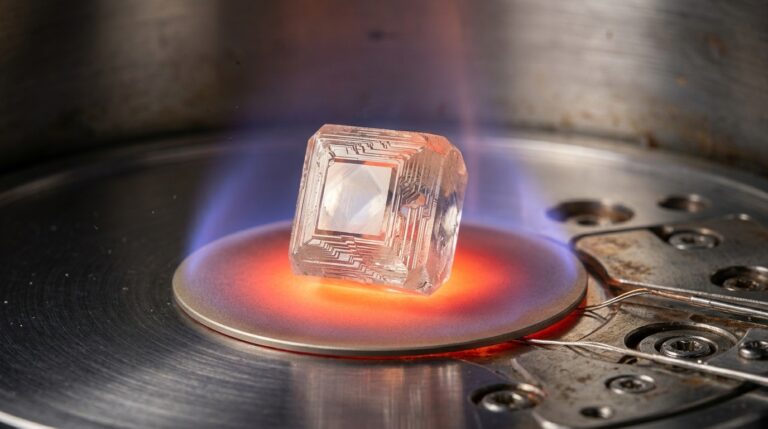

Beyond the surface, lab-cultivated and mined diamonds share an identical physical truth that often surprises the modern collector. At their core, both are genuine diamond crystals, both submit to the same geometric scrutiny of the 4Cs, and both possess the quiet majesty required to anchor an heirloom piece. Nonetheless, they hold distinct positions in both the marketplace and the heart. Choosing between them is a matter of prioritizing different virtues—balancing their geological history and practices against the innovation of modern science, alongside their contrasting pricing models and global origins.
The Common Blueprint. Beneath their differing origins, lab-grown and earth-born stones are bound by an identical physical truth. Both are pure carbon crystals sharing the exact legendary hardness and mesmerizing relationship with light. Neither path guarantees flawless perfection; stones from either environment can exhibit natural variances in tone, internal growth characteristics, fluorescence, and the precision of their finish. Consequently, premier gemological institutes analyze both selections with the same rigorous instrumentation, permanently recording their weight, clarity profile, and identifying proportions on official certificates.
Divergent Origins
While their physical performance is identical, their backgrounds represent two entirely different worlds. Mined diamonds are artifacts of the Earth’s deep history. Lab-grown diamonds are a testament to human innovation, created at will using sophisticated technological chambers. This structural departure in how they are born means that while standard jeweler tools cannot differentiate them, world-class grading laboratories can readily identify their path of origin using highly specialized spectroscopic analysis.
A Study in Rarity and Real Value
Lab-grown diamonds generally command a vastly different price point than their mined counterparts. Their significant affordability stems from specialized growth efficiencies, making them a compelling option and an incredibly accessible path to luxury. In contrast, the mined stones remain deeply tied to their geological history. Regardless of which origin resonates with your personal philosophy, a secure purchase relies on clear documentation. Requesting a verified report from a world-class grading authority safeguards your investment and honors the true identity of the gemstone.
The Human and Environmental Footprint
A diamond’s journey shapes its true narrative, making environmental and human considerations an essential chapter for the modern buyer. Traditional mining carries profound societal and ecological weights, directly altering fragile landscapes and, in unregulated regions, exposing local communities to human rights abuses and systemic child labor exploitation; with this, laboratory creation processes completely divorce the gemstone from these severe human vulnerabilities. It replaces vast earth extraction with sophisticated engineering and modern facilities, creating an ethical sanctuary for diamond growth. Ultimately, selecting a lab-grown diamond guarantees an origin completely untainted by human suffering, providing an innovative path forward that honors both human dignity and modern transparency.
A Choice of Virtues
Rather than viewing these two paths as competitors, it is more rewarding to see them as two distinct virtues of the modern world. To choose a natural stone is to embrace the romance of geological history. To choose a laboratory-grown diamond is to celebrate the triumph of human engineering, absolute transparency, and an unwavering commitment to human rights. Both journeys yield a gemstone of breathtaking, lifelong brilliance. The right decision is simply the one that honors your own values, supported by verified gemological documentation and a clear understanding of each stone’s unique beginning.
Frequently Asked Questions
Can one be visually distinguished from the other?
In a side-by-side comparison of equal grades, there is no discernible difference. They possess the identical refractive index and optical blueprint, meaning their brilliance, fire, and sparkle are visually identical to any observer.
Does the certification process differ?
The fundamental criteria are identical. Independent laboratories analyze both using the standard 4Cs matrix. The only variance lies in transparency; reputable grading reports will simply use clear, specific, and explicit designations to disclose the stone’s path of origin.
Which retains its market value over time?
While the secondary market remains inherently unpredictable for both paths, they behave in entirely distinct ways. Mined diamonds rely on a traditional market structure, whereas lab-grown diamonds thrive on a modern model of technological accessibility and the ethical value of sustainability.
Key Takeaways
- They are the same material with different origins.
- Natural rarity and manufactured supply create different pricing.
- Both should be independently graded and clearly disclosed.
- Sustainability claims require evidence, not assumptions.
Authoritative Sources
- GIA — Is There a Difference Between Natural and Laboratory-Grown Diamonds?
- GIA — Laboratory-Grown Diamond Report
- IGI — Commitment to Full 4Cs Grading
- GIA — Sustainability Report 2022
- GIA — The Extraordinary Backstory of Natural Diamonds
Halo Diamonds Editorial Note: Trusted independent authorities and reputable gemological institutions
must deliver precise, universally verifiable grading certificates that bring absolute transparency to every evaluation.