
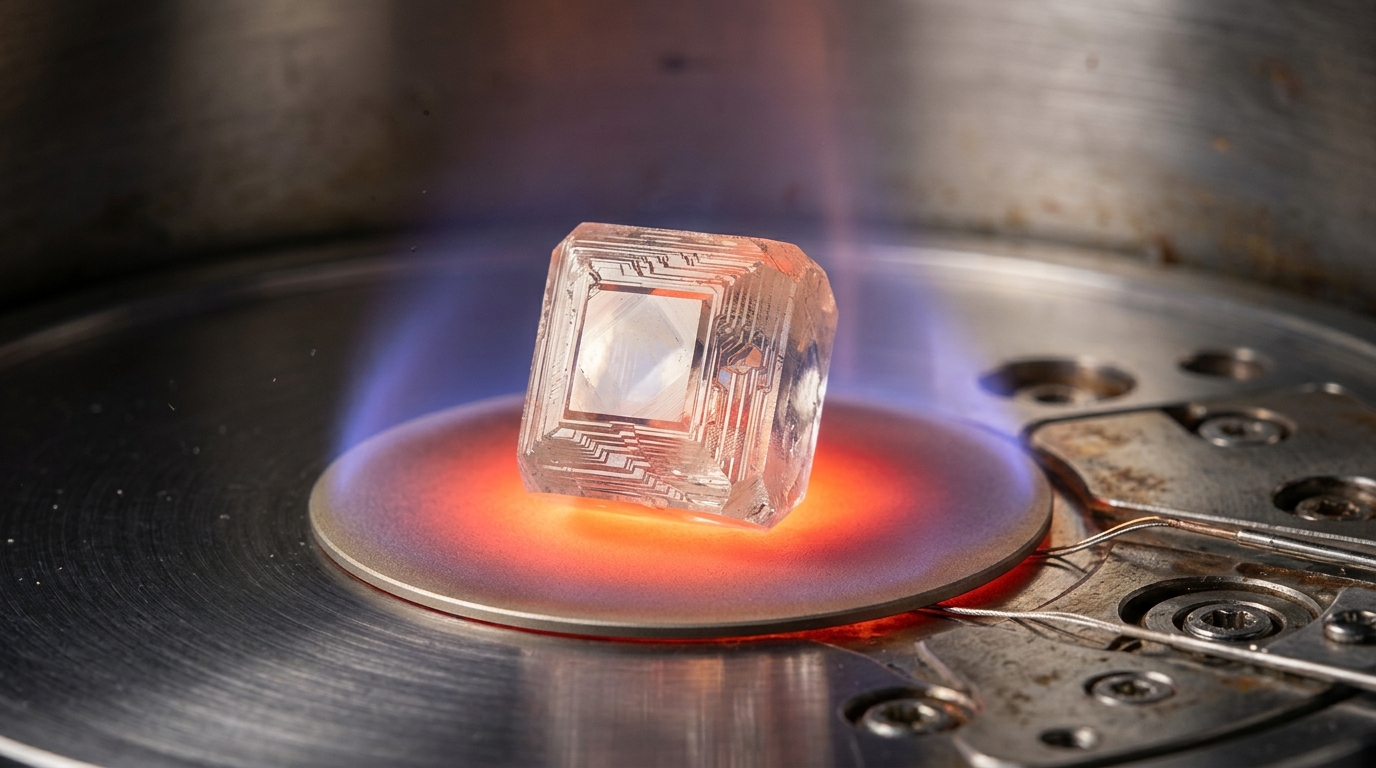
The creation of a laboratory-grown diamond relies on two masterfully established pathways: High Pressure High Temperature (HPHT) and Chemical Vapor Deposition (CVD). While each process begins with the singular focus of a diamond seed to cultivate a genuine diamond crystal, their technical journeys remain distinctly different. Ultimately, neither methodology inherently holds a superior claim over the other; both are separate arts of innovation yielding the exact magnificent result.
HPHT: High Pressure High Temperature
The mechanics of HPHT technology rely on a carefully engineered balance of force and heat, positioning a diamond seed with a carbon source and a metallic solvent inside a high-tech press. These extreme conditions cause the carbon to dissolve and seamlessly bond to the seed, constructing a genuine diamond crystal from the inside out. Notably, this method possesses a versatile legacy beyond this initial birth; HPHT serves a secondary artistry: it can be precisely applied post-growth to gently refine and elevate the color of a finished diamond, unlocking its truest clarity.
CVD: Chemical Vapor Deposition
The artistry of CVD technology mirrors the slow, magnificent geometry of nature, but executes it within a highly controlled atmosphere. By introducing a methane and hydrogen gas mixture into a specialized chamber and applying targeted energy, the technology frees carbon atoms to bond directly onto thin diamond seed plates, constructing the gemstone layer by microscopic layer. Following this sophisticated growth cycle, some CVD stones undergo specialized finishing treatments to elevate their color body to a colorless grade. This step reflects the continuous evolution of diamond engineering—a detail that world-class grading laboratories will always discover and proudly disclose to maintain absolute consumer trust.
From Rough Crystal to Finished Diamond
The birth of the rough crystal is merely the prologue; its true brilliance is awakened during the post-growth journey of planning, laser slicing, faceting, and meticulous inspection. In the world of fine jewelry, craftsmanship is the true equalizer. A state-of-the-art laboratory can grow a dense, heavy rough crystal, but poor cutting decisions will leave it dull and lifeless. Meanwhile, an expert planner and a master artisan can navigate the grain lines of a modest rough stone to reveal a finished diamond of unparalleled fire and brightness.
Does Growth Method Affect Appearance?
In the realm of pure sparkle, the distinction between HPHT and CVD technology becomes beautifully invisible. Although each method imprints a diamond’s microstructure with unique growth features and spectroscopic signatures, these details serve only as identifiers for independent laboratories, not indicators of a stone’s elegance. A confident purchase relies on looking past the machinery of innovation and focusing squarely on the final masterpiece. Prioritize the metrics that directly define its brilliance: the mastery of its cut, its color tone, its clarity, its light transparency, and the security of a premier gemological certificate.
Frequently Asked Questions
Does the HPHT process possess a more natural character?
No. Both HPHT and CVD remain purely technological achievements. While one replicates planetary pressure and the other utilizes gas synthesis, both are born entirely within the modern sanctuary of a laboratory.
Does one methodology inherently yield superior quality?
Is one manufacturing technique automatically superior to the other?
No. Excellence does not come from the machinery used. Exceptional, average, and modest crystals are produced within both disciplines, making the individual attributes of each stone the true test of quality.
Is post-growth treatment something to be avoided?
Not at all. A post-growth treatment is not a flaw or a structural defect; it is simply a continuation of the engineering process. However, to maintain consumer confidence, any such enhancement must be discovered, verified, and explicitly stated on an official grading report.
Key Takeaways
- HPHT and CVD engineering both synthesize a genuine diamond crystal lattice.
- Provenance of growth does not serve as a benchmark for aesthetic brilliance.
- The ultimate visual performance relies squarely on cutting precision and objective grading.
- Premier independent certificates provide complete disclosure regarding origin and subsequent
treatments.
Authoritative Sources
- GIA — HPHT and CVD Diamond Growth Processes
- GIA — Laboratory-Grown Diamonds: An Update on Identification
- GIA — Simulants, Moissanite and Lab-Grown Diamonds
- GIA — Laboratory-Grown Diamond Report
Halo Diamonds Editorial Note: Trusted independent authorities and reputable gemological institutions
must deliver precise, universally verifiable grading certificates that bring absolute transparency to every evaluation.